Market Trends
August 2026 Market Smart:
Housing downturn widens, but buyer leverage is the real story
Australia’s housing downturn broadened through winter. National values fell 0.9% in August, a fifth straight monthly decline, taking values 3.6% below March’s peak. 93% of capital city suburbs recorded a fall over the past three months, up sharply from under half in autumn.
For prepared investors, that’s the opportunity. Selling times are stretching, auction clearance rates sit below 50%, and vendors are becoming realistic on price. Rental yields have climbed to their highest level since 2019 at 3.79% nationally, while rents keep growing 5.7% a year. Perth, Brisbane, Adelaide and Darwin are still recording double-digit annual growth, and Darwin was the only capital to add value over the quarter.
This month’s Market Smart breaks down where the leverage now sits.

Key Take Aways
Downturn broadens
93% of capital city suburbs fell over winter, up from under half in autumn, as weaker conditions spread beyond premium markets.
Sydney leads the fall
Down 7.1% from its February peak, outpacing the 2022-23 correction at the equivalent stage.
Yields hit a 6-year high
National gross rental yield reached 3.79% in August, the strongest since September 2019.
Darwin bucks the trend
The only capital to record a three-month gain, up 0.9% and 14.6% annually.
Buyers gain leverage
Listings up 24% year-on-year, clearance rates below 50%, sales volumes down 15.5%.
Rate risk resurfaces
Stronger inflation data has revived talk of another RBA hike this spring.
What’s moving and what isn’t
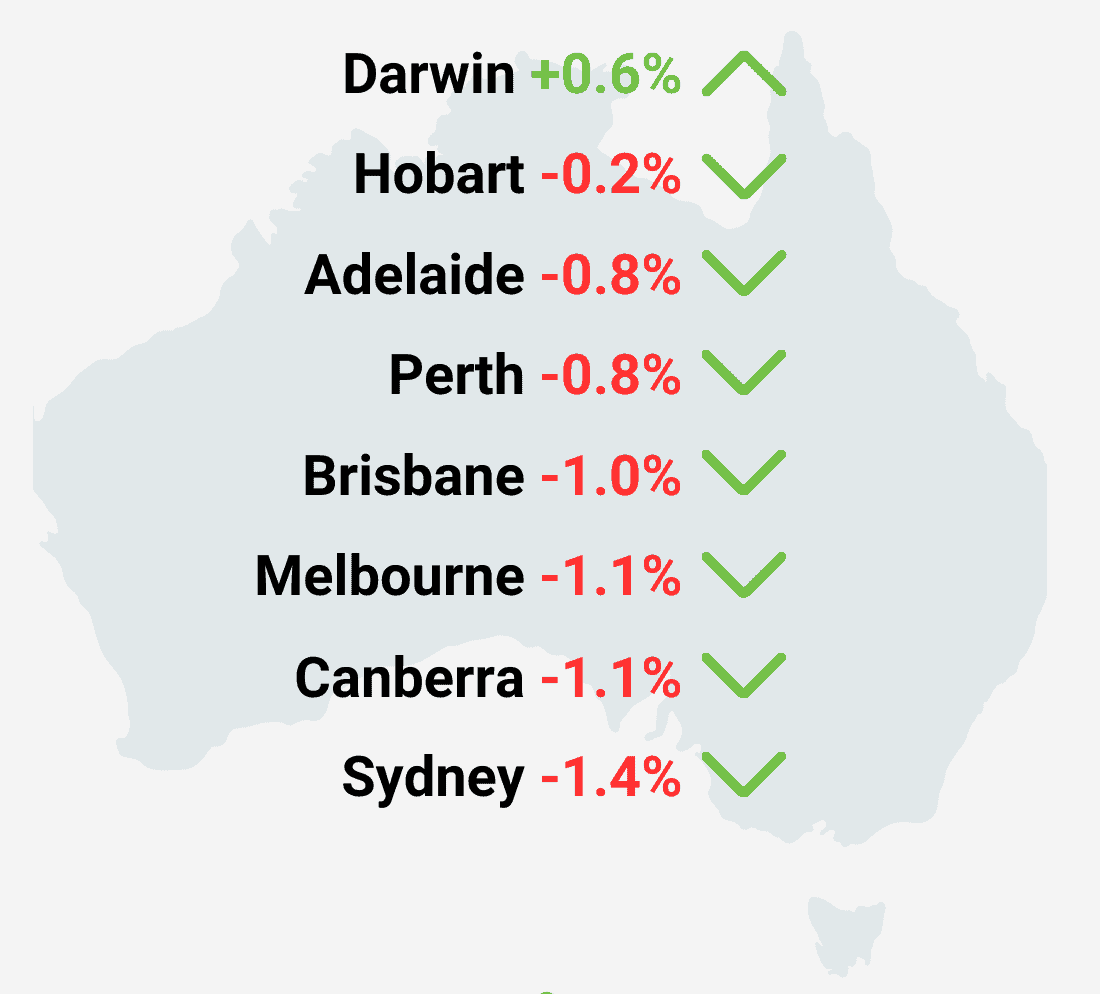
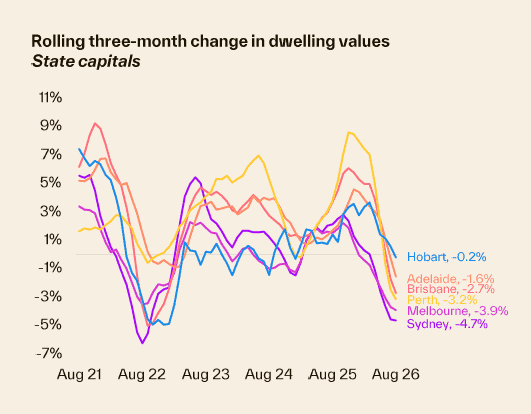
Every capital except Darwin fell over winter. Sydney continues to lead the pace of decline, down 1.4% in August and now 7.1% below its February peak, a steeper fall than the 2022-23 correction at the same stage. Melbourne (-1.1%) and Canberra (-1.1%) followed closely, with Brisbane (-1.0%), Perth and Adelaide (both -0.8%) not far behind.
Darwin remains the standout, up 0.6% in August and 0.9% over the quarter, extending its annual growth to 14.6%. Perth (+15.6%), Brisbane (+10.8%) and Adelaide (+8.6%) are still delivering strong yearly gains despite the softer monthly pace.
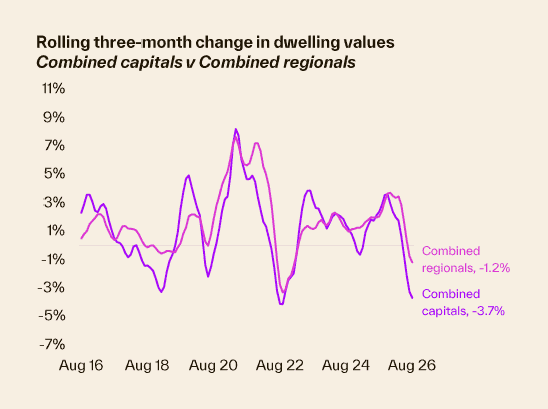
Regional markets are proving more resilient than the capitals, down just 0.4% in August against the combined capitals’ 1.1% fall. Regional South Australia was the only broad rest-of-state market to avoid a three-month decline, a sign of where relative strength is holding up best right now.
Cotality 2026
How buyers and sellers are feeling now
Conditions have shifted firmly in buyers’ favour. Combined capital city listings were 24% higher than a year ago and 8% above the five-year average over the four weeks to 30 August, even though the flow of fresh listings is actually 6% below year-ago levels. That accumulation of stock, rather than a rush of new sellers, is what’s giving buyers so much more choice.
Auction clearance rates have held below 50% since late May, and estimated home sales over the June quarter were tracking 15.5% below a year ago. Brisbane, Perth and Sydney recorded the largest falls in transaction activity, down more than 20% year-on-year.
For buyers with secure employment and finance ready to go, that’s real negotiating power: longer selling times, larger vendor discounting and less competition for well-presented homes. Consumer sentiment has lifted off its lows too, giving cautious optimism that confidence is beginning to stabilise.
Rents keep climbing as yields hit a six-year high
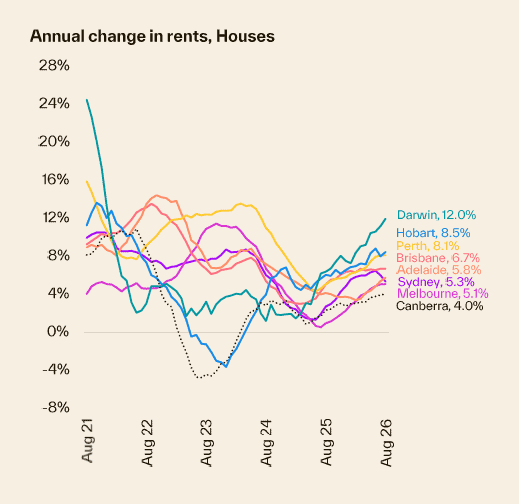
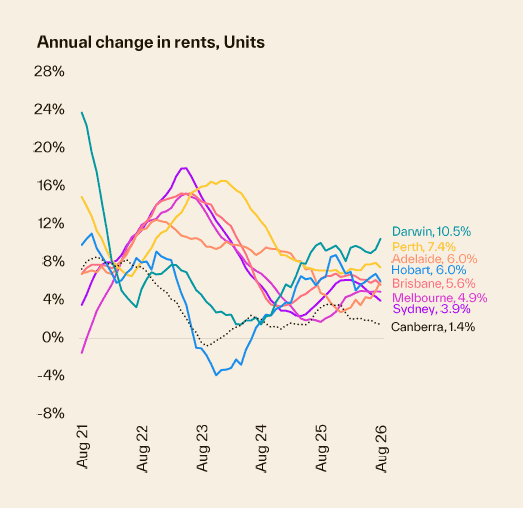
National rents grew 0.4% in August, matching July’s pace, and are up 5.7% over the year, adding roughly $38 a week to the typical rent. Over five years, rents have surged 39%, meaning renters are now paying around $200 more per week than they were in 2021.
Perth has delivered the biggest five-year rental gain of any capital, up 56% and adding roughly $283 a week to the median rate. Darwin remains the strongest yielding capital nationally at 6.3%, with Hobart close behind at 4.4%.
With values falling and rents still rising, the national gross rental yield has pushed up to 3.79%, its highest level since September 2019. Vacancy rates edged up slightly to 1.9% in August but remain well below the decade average of 3.3%, keeping the fundamentals firmly in landlords’ favour and improving the cash flow case for new investors entering the market now.
Cotality 2026
Will the RBA raise rates again this spring?
The RBA held the cash rate steady at 4.35% through winter, but stronger than expected inflation data has reopened the debate. A growing number of economists now think another hike in September or November is possible, which would be the first increase since the current pause began.
Cotality’s Tim Lawless notes the risk profile for housing has “shifted more firmly to the downside,” with sticky inflation and household budget pressure likely to keep demand subdued through spring. Real wages have fallen for four consecutive quarters, adding to the squeeze on borrowing capacity.
The upside for investors is that this uncertainty is exactly what’s keeping buyer competition low and vendor expectations realistic. A rate pause confirmed later this year could be the catalyst that brings hesitant buyers back to the table, meaning the current window of elevated stock and reduced competition may not last indefinitely. Well-funded buyers who move now are positioning ahead of that shift.
Things to keep an eye on
Rate direction remains the swing factor. The RBA held at 4.35% through winter, but firmer inflation data has some economists pencilling in another hike this spring. A confirmed pause, when it comes, has historically been the trigger for buyer demand to return quickly, so this is the single most important variable to track over the next two reporting periods.
The downturn is broadening, not deepening in any one segment. The share of falling capital city suburbs has more than doubled since autumn to 93%, and the gap between premium and entry-level performance is narrowing. This spread across price points, rather than concentration in one segment, is worth watching for early signs of stabilisation.
Supply remains structurally tight. New housing completions are still running below what population growth requires, and the 5% deposit scheme for first home buyers continues to support the more affordable end of the market. This underlying shortfall is the main factor limiting how far this downturn can realistically run.
Regional South Australia and Darwin are bucking the trend. Both avoided a three-month decline in values, and Darwin posted the only positive monthly result of any capital. Worth watching whether this resilience broadens to other secondary markets over spring.