Market Trends
July 2026 Market Smart:
Downturn widens in July:
Why buyers now hold the cards
July delivered the sharpest monthly fall in national home values since December 2022, down 0.7%. And this time it wasn’t just Sydney and Melbourne. Brisbane and Adelaide, the market’s recent standouts, have now joined the slide too.
Here’s the opportunity hiding in that headline: this is exactly the kind of market that rewards buyers who are ready to move. Auction clearance rates are climbing back toward 50% after a rough June, vendor discounting is on the rise, and total listings are edging closer to average after a stretched first half of the year. Rental yields, meanwhile, just hit their highest point since 2019.
Softer prices, better negotiating room, and rising income potential. For prepared investors, July was a month worth paying attention to.

Key Take Aways
Sharpest fall since 2022
National values dropped 0.7% in July, the biggest monthly decline in almost four years.
Downturn broadens
Brisbane (-0.6%) and Adelaide (-0.2%) joined the slide, both posting a second straight monthly fall.
Darwin bucks the trend
It remains the only capital still recording price growth, backed by strong yields and affordability.
Yields hit a six-year high
Combined capital gross yields reached 3.56%, the strongest reading since August 2019.
Rate pause likely, not guaranteed
Inflation came in soft, but the RBA has flagged it still holds a tightening bias.
Investors eye the budget shift
New negative gearing and CGT rules are reshaping demand for established homes ahead of mid-2027.
What’s moving and what isn’t
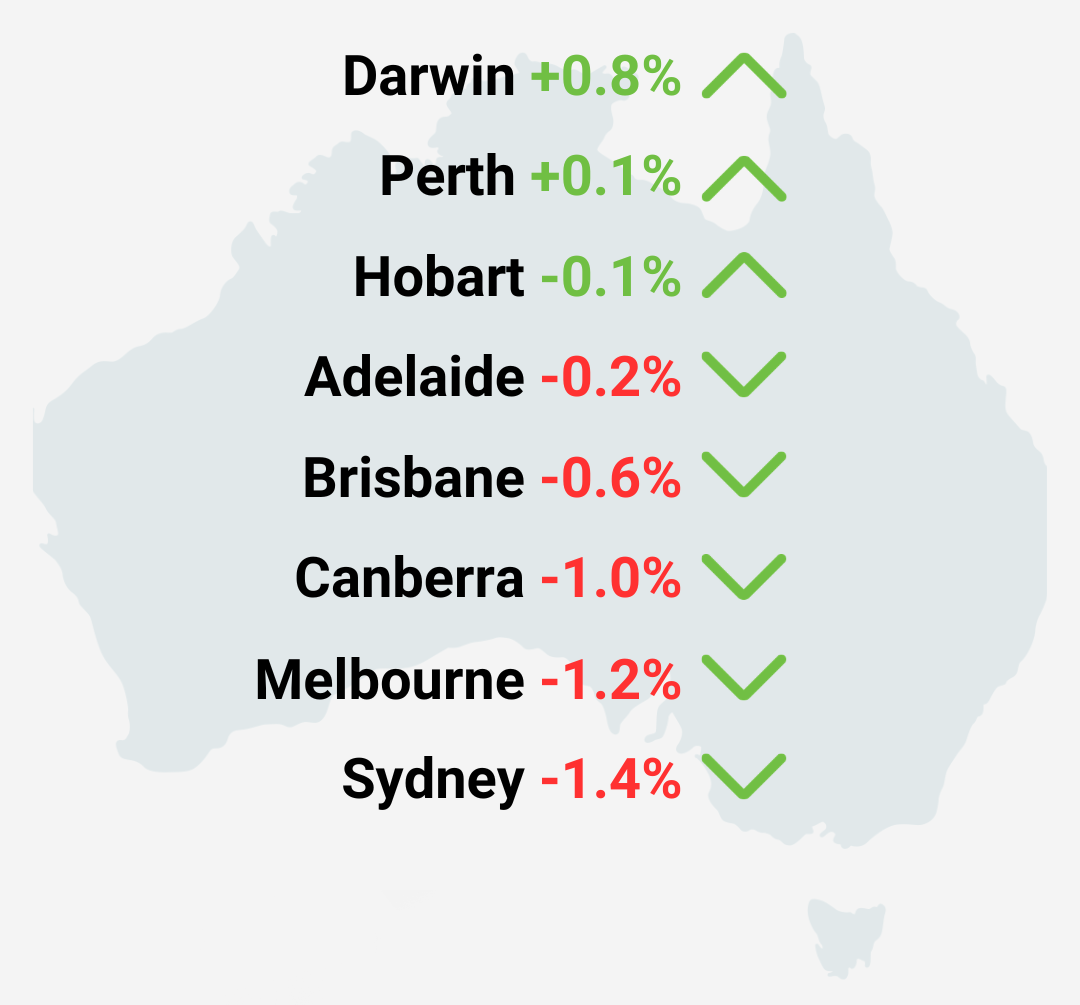
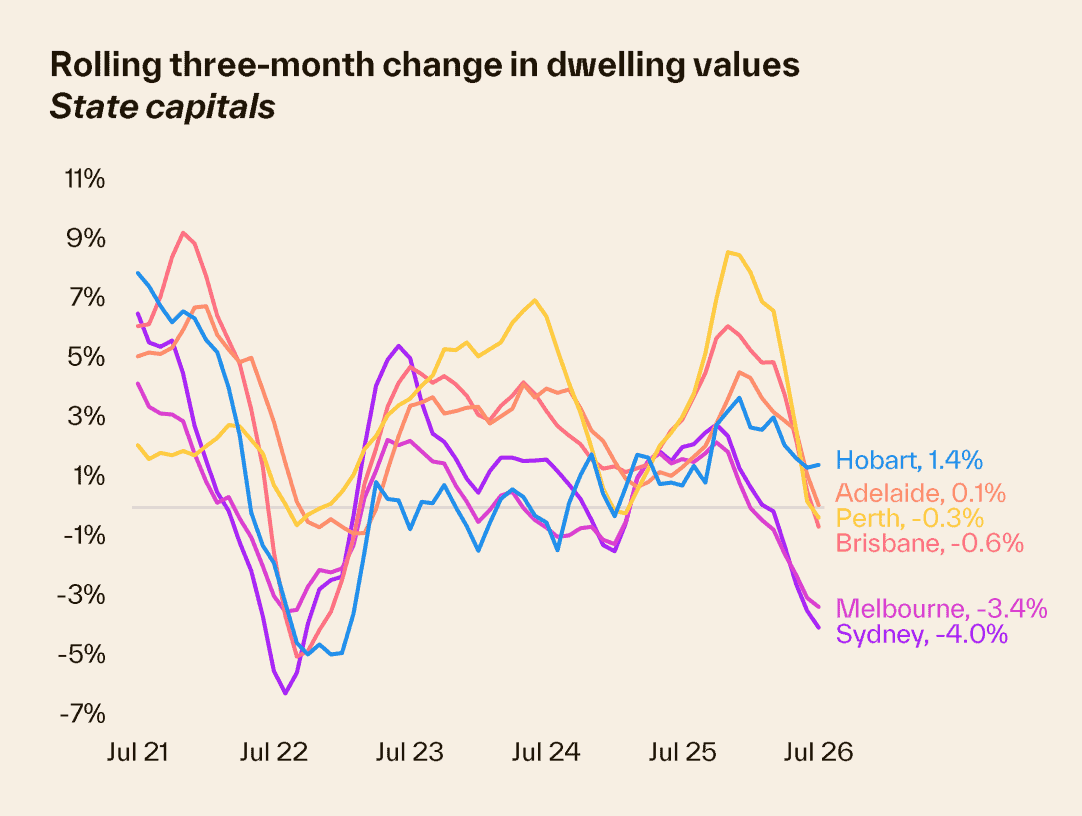
Sydney (-1.4%) and Melbourne (-1.2%) remain the biggest drags on the national number, but the real story in July is who joined them. Brisbane fell 0.6% and Adelaide slipped 0.2%, both recording a second straight monthly decline after a long run as the market’s strongest performers.
Perth held its ground with a modest 0.1% gain, though June’s result was revised down to a 0.5% fall, pulling the “boom city” into negative territory for that month too. Darwin remains the standout, the only capital still moving upward, supported by strong rental yields and comparative affordability.
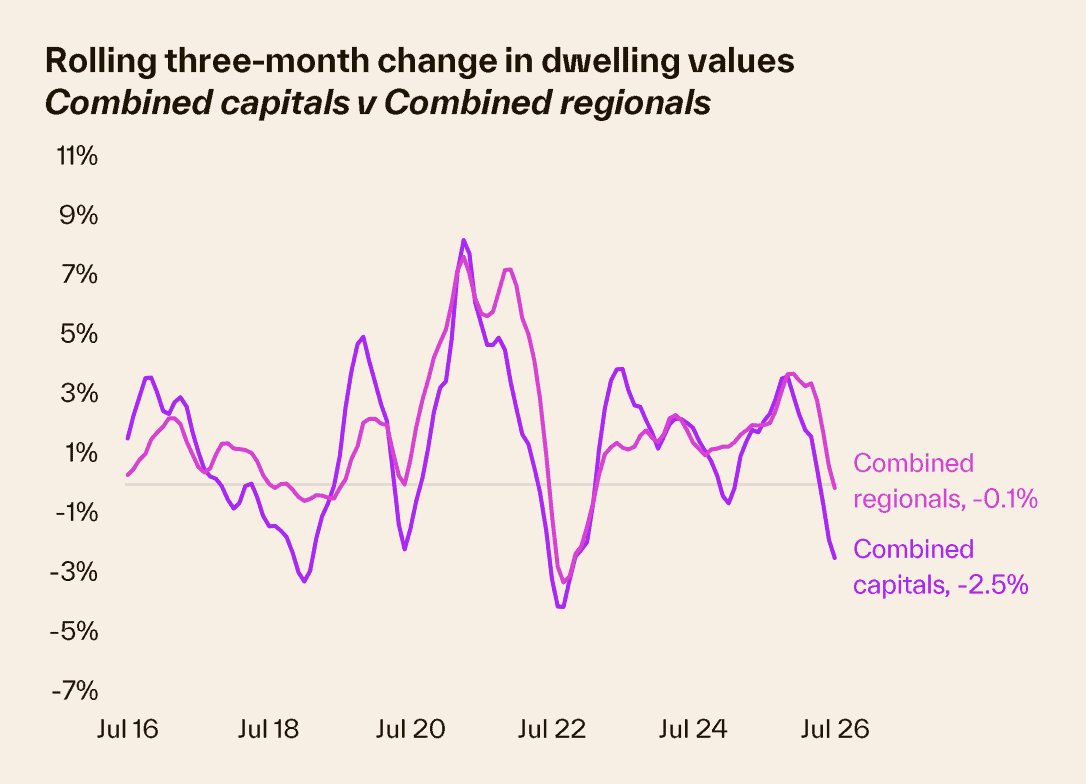
Regional markets weakened as well, dipping 0.2% nationally, their first decline since January 2023. Regional WA (+0.9%) and regional SA (+1.4%) bucked the trend, still finding buyers where affordability holds up.
Cotality 2026
How buyers and sellers are feeling now
Momentum is shifting in buyers’ favour, and the numbers back it up. National dwelling values now sit 2.0% below their March peak. Upper-quartile properties fell 3.2% over the three months to July, while the more affordable end of the market held up with a small 0.3% gain, a sign that competition is concentrated where prices are most accessible.
Sellers are starting to adjust too. New listing flow has slowed, particularly in Sydney, as vendors wait for conditions to improve. But total advertised stock is still running 5.7% above the five-year average across the capitals, giving buyers more choice than they’ve had in years.
Consumer sentiment ticked up 4.1% in July from weak June levels, though it remains well below last year’s highs, a sign confidence is fragile but not broken.
Yields hit a six-year high as rents keep climbing
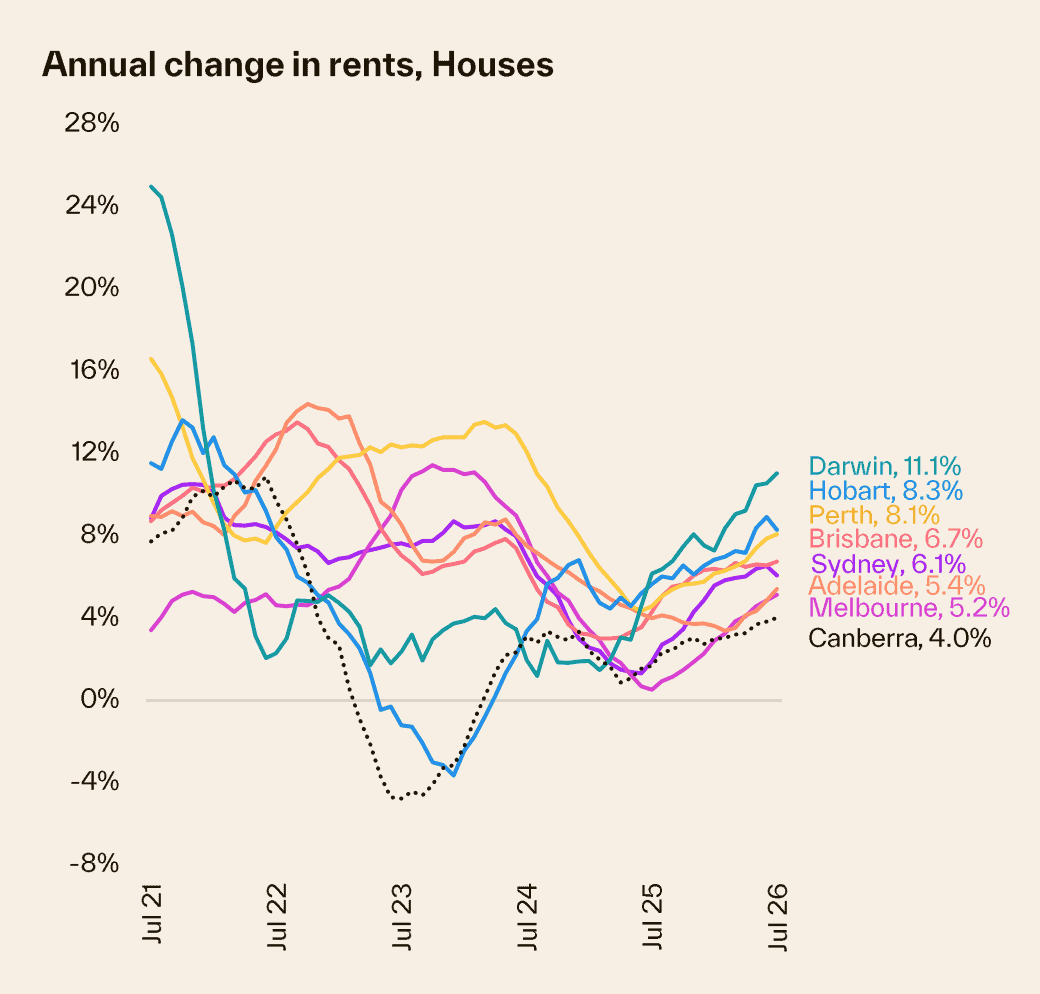
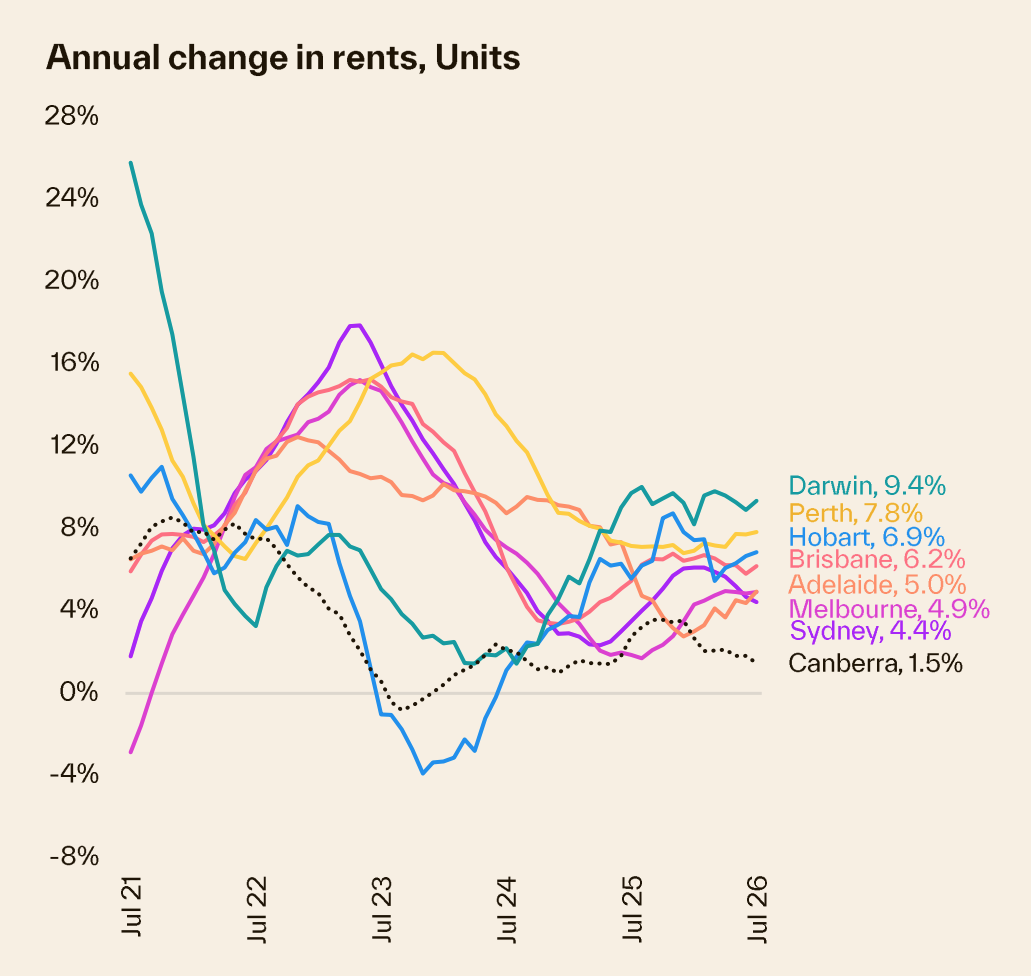
Rental growth held firm through July, with the national rental index up 0.4% for the month and annual growth steady at 5.9% for a third straight month. That’s added roughly $40 a week to the median rent over the past year.
The standout figure for investors: combined capital city gross rental yields climbed to 3.56%, the highest reading since August 2019. Melbourne now leads the pack among the major capitals at 4.0%, while Sydney (3.3%) and Brisbane (3.4%) sit at the softer end.
It’s a gradual shift, but a meaningful one. As home values ease and rents keep climbing, the income side of the investment equation is improving in ways it hasn’t in years, even with mortgage rates still elevated for new investor loans.
Cotality 2026
Rate pause holds, but the RBA isn’t ruling out more hikes
Interest rates were the quiet good-news story of July. Underlying inflation showed no increase in the June quarter, a softer outcome than markets expected, reinforcing the view that the cash rate has likely peaked at 4.35%.
But it’s not a done deal. The RBA Governor used a July speech to remind markets the board retains a tightening bias, meaning inflation and unemployment data over coming months will still matter enormously for where rates head next.
Adding a little near-term pressure: the temporary fuel excise discount ended on 2 August, which will bite into household budgets just as the spring selling season gets underway. For buyers watching borrowing costs closely, the message is cautious optimism rather than an all-clear.
Things to keep an eye on
The downturn’s breadth is the story to watch closest. What started as a Sydney and Melbourne problem has now pulled in Brisbane and Adelaide, two cities that had powered much of the market’s strength over the past two years. Whether this spreads further into Perth and the remaining resilient markets, or whether it stabilises here, will shape the second half of 2026.
Inflation and the labour market remain the key swing factors for interest rates. With underlying inflation flat in the June quarter and the RBA’s tightening bias still on the table, every data release between now and the next Board meeting carries extra weight.
Investor behaviour following the federal budget’s tax changes is another one to track. Negative gearing is being wound back to new builds from mid-2027, and the capital gains tax discount is being replaced with an indexed cost base approach. The near-term effect has been a pullback in investor appetite for established homes, and how far that goes will influence pricing in investor-heavy suburbs specifically.
On the suburb research side, HtAG’s July update points to a similar theme playing out at the micro level. After a period where investor activity tilted heavily toward the most affordable, highest-yielding pockets of the country, that “cashflow tilt” looks to be cooling. Craigieburn (VIC) has reportedly reclaimed the top spot in suburb popularity rankings, while some of the standout results out of regional Tasmania in recent months appear to have eased. We’re confirming the specific figures behind this shift before including exact numbers.
Finally, keep watching vendor behaviour. New listings have slowed, particularly in Sydney, but total stock remains elevated. If that combination persists, it typically means longer selling times and more room to negotiate for buyers heading into spring.