Market Trends
October 2026 Market Smart:
Spring stock builds as buyers gain the upper hand in October
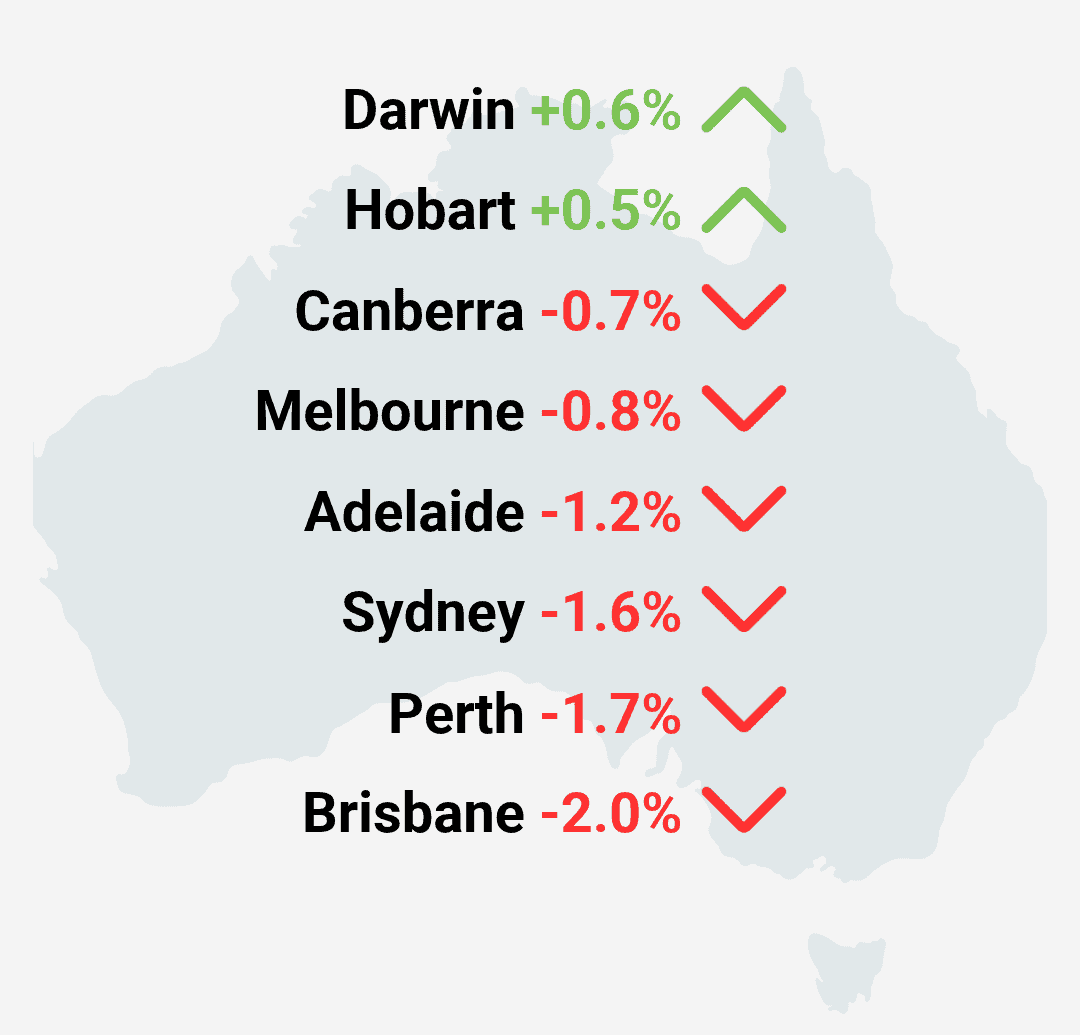
October brought more of the same for the property market. Cotality’s national Home Value Index fell 1.2%, the seventh fall in a row. Values are now 6.7% below their March peak, which is about $63,400 off the value of the median Australian home. Brisbane and Perth led the decline, while Darwin and Hobart bucked the trend with small gains.
For investors, conditions have moved firmly in buyers’ favour. Listings are at their highest level for this time of year since 2019 and homes are taking longer to sell. Vendor discounts are the biggest since 2019, and capital city rental yields haven’t been this high since 2015. Here’s what moved in October and how you can use it to your advantage.

Key Take Aways
Rates hit an 18-year high
The RBA lifted the cash rate to 4.85% on Melbourne Cup Day, its fifth hike this year, with three board members voting to hold.
Inflation runs hot
Annual headline inflation rose to 4.3% in September and the trimmed mean reached 3.7%, well above the RBA’s 2–3% target band.
Auctions at a five-year low
Capital city clearance rates averaged around 45% in October, the weakest result since April 2020, and Brisbane averaged just 25%.
More time, bigger discounts
Homes are taking a median of 39 days to sell, and vendor discounting has widened to 4.7%, the largest since May 2019.
Yields at an 11-year high
Gross rental yields across the combined capitals climbed to 3.77% in October, their highest level since May 2015.
Victoria leads the research
Victoria took a record 53.9% of national property research on HtAG in October, with Sunbury again the most-researched suburb.
What’s moving and what isn’t
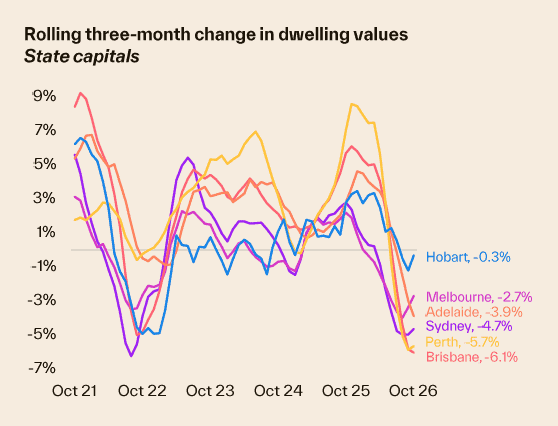
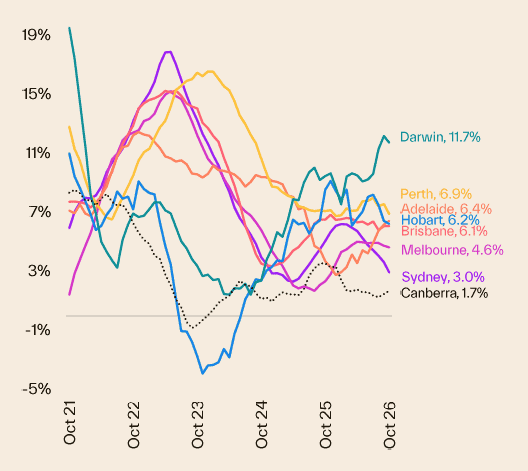
Brisbane recorded the steepest fall of the capitals in October, down 2.0%, followed by Perth (-1.7%) and Sydney (-1.6%). Brisbane and Perth have both dropped close to 6% over the past three months, a sharp turnaround after six years of exceptional growth. Even so, both are still ahead of where they were a year ago.
Sydney is now 10.1% below its February peak, while Melbourne’s monthly fall eased to -0.8%. Darwin (+0.6%) and Hobart (+0.5%) were the only capitals to rise, and Darwin still leads annual growth at 9.7%.
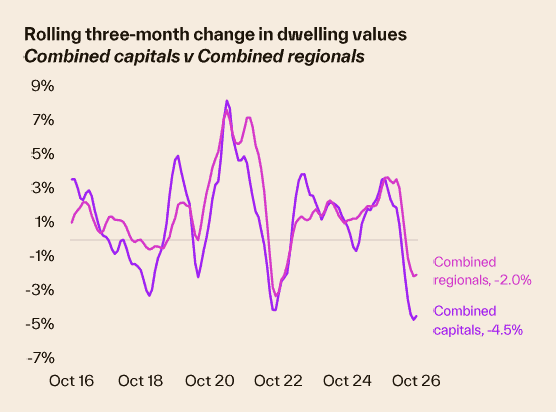
Regional markets continue to hold up better. Regional values were down 0.7% for the month but are still 3.4% higher over the year, while the combined capitals are down 4.8% over the same period.
Cotality 2026
How buyers and sellers are feeling now
Confidence slipped again in October. The Westpac–Melbourne Institute Consumer Sentiment Index fell 4.7% to 80.4, a six-month low, as higher fuel prices and interest rates kept households cautious. That caution is showing up in activity. Home sales over the past three months were 23% below a year ago, and around 30% lower in Sydney and Brisbane.
Auction clearance rates averaged about 45% across the capitals in October, the lowest since April 2020. The median time on market has stretched to 39 days, and vendor discounting has widened to 4.7%.
Sellers now need to be realistic on price. Buyers get more stock to choose from, less urgency and real room to negotiate.
Rent growth eases as yields hit an 11-year high
Rental markets loosened further through spring. The national vacancy rate rose to 2.3% in October, the highest since January 2022 and close to the decade average of 2.4%. Vacancies are higher than a year ago in every capital except Darwin.
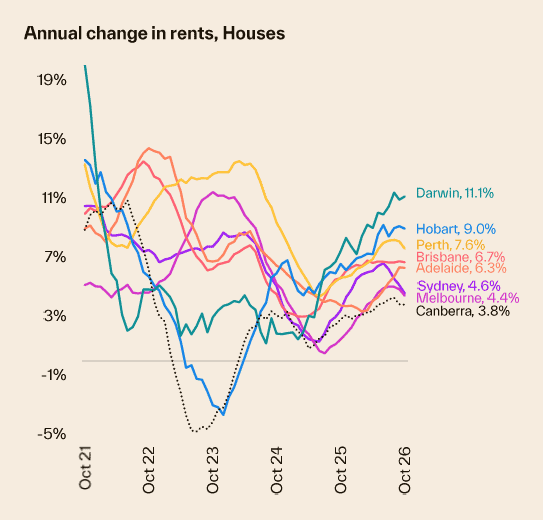
National rents rose 0.9% over the past three months, the smallest quarterly rise since January 2025. After rents rose 52% over six years, many tenants are close to the limit of what they can pay. Darwin remains the standout, with house rents up 11.1% and unit rents up 11.7% over the year.
The upside for investors is yield. Rents are still rising while values ease, so the gross yield across the combined capitals has climbed to 3.77%, its highest since May 2015.
Cotality 2026
Cup day hike takes the cash rate to 4.85%: What it means for you
On Melbourne Cup Day, the Reserve Bank lifted the cash rate by 25 basis points to 4.85%. It’s the fifth hike of 2026 and the highest cash rate since 2008. The move followed hotter than expected September inflation figures, with headline inflation rising to 4.3% and the trimmed mean reaching 3.7%, well above the RBA’s 2–3% target.
The decision wasn’t unanimous, with three of the nine board members voting to hold. CBA and NAB now expect the RBA to pause from here, which suggests the hiking cycle could be close to its peak.
Higher rates reduce borrowing capacity and narrow the pool of buyers who can get a loan, which is a big reason competition has dropped away. For investors with finance in place, that’s an opening. Fewer active buyers means more negotiating power, and buying when sentiment is weak has often let investors secure better entry prices.
Things to keep an eye on
Is this the peak for rates? The RBA next meets on 7–8 December. CBA and NAB expect a pause, while ANZ thinks another hike could come in December or February. The October inflation figures, due in late November, will be the signal to watch.
How much stock builds up. Fresh listings are running almost 18% below average, yet total stock keeps climbing because homes are selling more slowly. The longer that continues, the more pressure vendors will face to adjust their price expectations.
The jobs market. Unemployment rose to 4.7% in September, its highest level since 2021. A gradual softening is expected, but a sharper rise would weigh further on confidence and borrowing.
Where the research is heading. HtAG’s October data shows Victoria accounting for a record 53.9% of national property research. Queensland fell to a series low of 12.8%, sitting behind NSW for a second month. Tasmania and South Australia both lifted to 5.6%. Sunbury held the top spot, with Hamilton close behind and Dubbo back in the Top 20.
What’s limiting the downside. Low levels of new housing construction and ongoing population growth should help contain the downturn. Cotality expects a gradual drift lower in values rather than a sharp correction. That gives patient, well-researched investors a window to act while competition is light.